Power infrastructure cables operate under electrical, thermal, and mechanical stresses that can persist for decades. Insulation and sheathing compounds must maintain controlled dielectric behavior while tolerating heat, moisture, installation forces, and environmental exposure.
Intensive mixing of polymers with stabilizers, fillers, flame-retardant systems, and other additives takes place in a twin screw extruder before the compound reaches cable-processing equipment. DEKUMA develops twin-screw extrusion technology for polymer processing, including equipment configurations designed around demanding PVC formulations.
Building the Right Compound for Cable Applications
XLPE compounds begin with a polyethylene base whose molecular structure provides the foundation for electrical insulation. Crosslinking subsequently changes the material’s thermal and mechanical behavior, allowing the insulation to operate at elevated temperatures compared with ordinary thermoplastic polyethylene. During compounding, additives must be distributed consistently so that the final material behaves uniformly throughout the cable layer.
LSZH compounds follow a different formulation philosophy. Low-smoke, zero-halogen materials commonly use polymer systems combined with substantial quantities of mineral flame retardants. These fillers can strongly influence melt viscosity, dispersion, mechanical properties, and processing stability. Poor distribution may create local variations that affect both mechanical integrity and flame-response characteristics.
Armoured cables introduce another compound requirement in the form of filling materials. The filler occupies spaces within the cable construction, supporting the internal arrangement while contributing to moisture resistance and mechanical protection. Its processing requirements differ from those of a thin electrical insulation layer, so formulation design has to reflect the function, thickness, and downstream handling conditions of the finished cable.
Why Mixing Quality Affects Electrical Performance
Electrical insulation depends on more than the nominal resistivity of the base polymer. Contaminants, voids, poorly dispersed additives, and localized material defects can create weak points within the insulation. A homogeneous compound gives downstream cable extrusion a more consistent starting material, reducing the possibility that formulation variation becomes a localized defect in the finished layer.
Processing temperature requires careful control as well. Excessive thermal exposure can accelerate polymer degradation or alter additive behavior, while insufficient melting can leave poorly incorporated components. Residence time also matters because material that remains in the processing system for too long may experience a different thermal history from material passing through under stable conditions.
Mechanical mixing must match the formulation. High filler loading in LSZH compounds, for instance, places different demands on screw elements and wear surfaces than a relatively low-filled polymer system. The processing configuration needs to provide sufficient distributive and dispersive action while controlling shear and heat generation according to the compound’s characteristics.
Extrusion Components and Process Control
A twin screw extruder machine relies on coordinated feeding, conveying, melting, mixing, and pressure development rather than a single processing zone. Stable feeding is especially important when several ingredients have different bulk densities or flow characteristics. Variations at the feed stage can propagate through the melt and eventually appear as inconsistent compound composition.
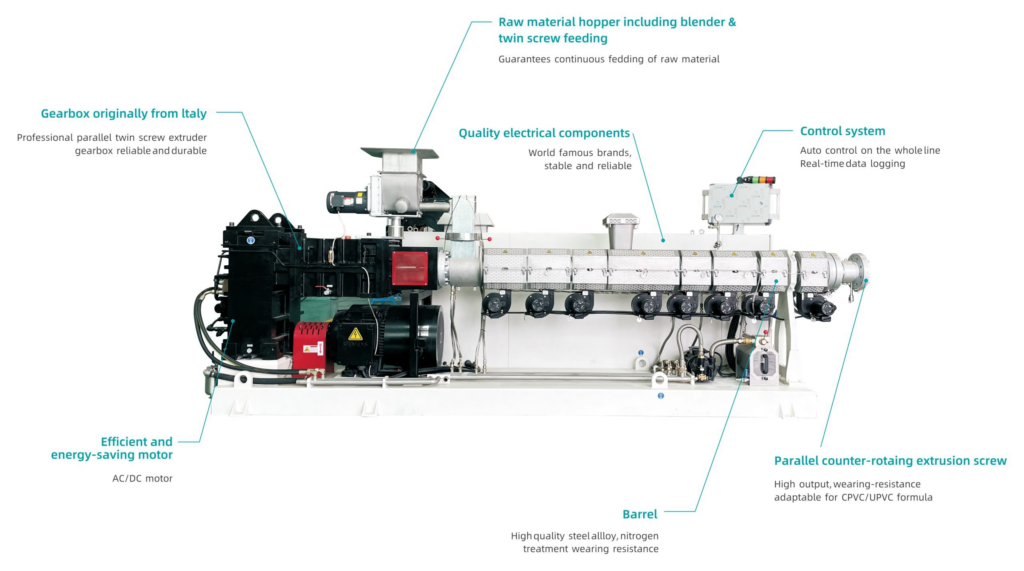
DEKUMA’s DKM-EII Twin-Screw Pipe Extruder incorporates an AC/DC motor, an Italian-imported gearbox, a raw-material hopper with blender and twin-screw feeding arrangement, nitrogen-treated alloy-steel barrel, wear-resistant twin extrusion screws, and an automatic control system with real-time data logging. The supplied specifications also identify the screw system as suitable for CPVC and UPVC formulations, while its listed DKM-EII51/105 configuration has a maximum output of 100–120 kg/h. These features describe the equipment platform; cable-compound production would still require application-specific screw configuration, formulation trials, and process validation.
Downstream quality depends on what happens inside the barrel, but measurement does not stop there. Melt temperature, pressure, motor load, feeding rate, and screw speed can provide useful process signals. Recording these parameters creates a production history that can be compared with laboratory results when a compound shows changes in electrical or mechanical behavior.
From Compound Testing to Cable Qualification
Compound inspection normally combines physical and electrical measurements. Tensile strength and elongation provide information about mechanical behavior, while volume resistivity, dielectric strength, and related electrical tests help characterize insulation performance. The relevant test methods and acceptance criteria depend on the cable type, material system, and applicable standard.
Thermal aging is another important evaluation because infrastructure cables may remain energized for long periods. Samples can be subjected to controlled thermal exposure before mechanical or electrical properties are measured again. Comparing initial and aged results helps identify whether the compound retains its required characteristics after prolonged temperature stress.
LSZH sheathing introduces additional checks related to fire behavior and smoke generation, while filling compounds may be assessed for compatibility, moisture behavior, and mechanical performance. A compound that looks consistent during pellet inspection still needs validation after cable processing because extrusion temperature, cooling, drawdown, and layer thickness can influence the properties of the finished insulation or sheath.
Conclusion
Power cable compounds have different roles within the same cable system, so their processing requirements cannot be treated as interchangeable. XLPE insulation emphasizes stable electrical and thermal performance, LSZH sheathing combines polymer behavior with demanding flame-retardant formulations, and armoured-cable filling compounds serve internal structural and environmental functions. Each material system calls for a processing window that reflects its chemistry and final application.
Reliable compounding begins with controlled ingredient feeding and continues through melting, dispersion, temperature management, and process monitoring. Laboratory measurements then provide another layer of evidence by connecting compound uniformity with electrical, mechanical, thermal, and fire-related performance. DEKUMA provides twin-screw extrusion equipment with controlled feeding, wear-resistant processing components, and real-time production monitoring, giving cable-material manufacturers a configurable platform for developing compounds around specific infrastructure cable requirements.