As renewable generation expands, power grids need greater flexibility to balance variable supply and changing demand. Utility-scale batteries can respond quickly, shift electricity across time, and provide grid support services. However, successful integration depends on more than installing an energy container. Project developers must coordinate battery systems with grid controls, power conversion equipment, communications, protection systems, and market requirements.
For grid-scale projects in 2026, the integration strategy should be developed alongside the storage system rather than after equipment selection. This approach can reduce commissioning risks and help ensure that the battery performs according to the grid’s operational needs.
Start with Grid Requirements and Operating Objectives
Every grid-scale storage project has a different purpose. A battery may be deployed for frequency regulation, renewable energy shifting, peak management, capacity support, congestion management, or several services simultaneously.
Before selecting equipment, developers should define required power, usable energy, response time, charging duration, discharge duration, cycling frequency, and expected operating profile. These requirements determine the appropriate system configuration and control strategy.
Design the Energy Container Around the Grid
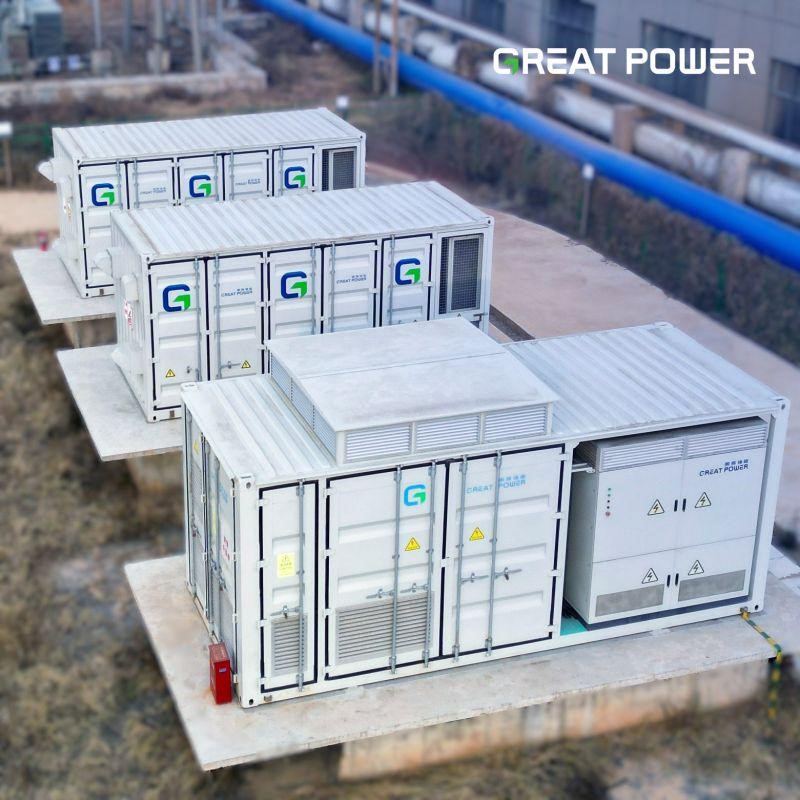
An energy container should be considered as one part of a larger electrical system. Its battery system must work together with the PCS, transformer, switchgear, EMS, SCADA platform, protection equipment, and grid connection infrastructure.
System integration should therefore be considered during the engineering stage. Developers should establish clear interfaces between the battery system and other equipment before procurement and commissioning.
Match Power and Energy to Grid Services
Power and energy capacity serve different purposes. Power determines how quickly a storage system can respond, while energy capacity determines how long it can sustain that response.
For frequency regulation, rapid power delivery may be more important than long-duration energy. For renewable energy shifting, a larger energy capacity may be required to move electricity from periods of high generation to periods of high demand.
Select the Right Large-Scale Configuration
Great Power’s large-scale portfolio provides several configurations that can be evaluated according to project requirements. The Max 6250 uses self-developed Ultra 588Ah battery cells and a high-safety liquid-cooled PACK, combined with a six-level safety protection system for liquid-cooled energy storage cabinets.
The Max 5000 takes a different approach with an integrated 20-foot container design. Its published specifications include battery cell efficiency of at least 96% and DC-side round-trip efficiency of 96% at 0.25P and 95% at 0.5P.
The Max 3440 is designed for highly integrated deployment and supports third-party SCADA and cloud-based EMS integration. Its published application scenarios include wind and photovoltaic generation, peak-valley price environments, and areas with significant daily load fluctuations.
Prioritize EMS and SCADA Integration
A grid-scale battery needs reliable control and monitoring. The EMS determines operating strategies, while SCADA enables centralized monitoring and interaction with broader plant infrastructure.
Before commissioning, project teams should verify communication protocols, command priorities, measurement accuracy, alarm handling, data refresh rates, and fallback behavior. The system should also clearly define which device has authority over charging and discharging commands.
Third-party integration should be tested under realistic operating conditions. Simulating only normal operation may leave problems undiscovered when the grid sends rapid commands or when communication is temporarily interrupted.
Commission the System Through Realistic Tests
Commissioning should verify more than whether the battery can charge and discharge. Functional testing should cover communication, protection, power response, EMS commands, SCADA signals, emergency functions, and interaction with the grid.
Performance tests should reflect the services the project will actually provide. If the system is intended for frequency regulation, for example, testing should evaluate its ability to follow changing power commands accurately and repeatedly.
Fault scenarios should also be considered. Communication loss, abnormal measurements, protection activation, and unexpected grid conditions can reveal whether the system transitions safely between operating states.
Plan for Long-Term Grid Operation
Integration does not end when commissioning is complete. Utility energy storage systems may operate for many years, during which grid conditions, market rules, software, and operating strategies can change.
Regular performance reviews should examine availability, efficiency, temperature behavior, alarms, cycling patterns, and degradation. Software and control-system changes should be documented and tested before deployment.
Maintenance planning should also include spare parts, remote monitoring, service response, firmware management, and periodic safety inspections. These measures can help preserve system availability throughout the operating lifecycle.
Why Great Power Supports Grid-Scale Integration
Great Power has developed storage solutions spanning cells, packs, racks, cabinets, and containers, allowing project teams to evaluate system architectures at different levels. Its energy storage portfolio serves utility-scale, C&I, residential, and other applications, with products deployed across more than 50 countries and areas.
Its large-scale systems address different integration priorities. The Max 6250 emphasizes high-capacity storage with liquid cooling, the Max 5000 combines an integrated container architecture with high published efficiency, and the Max 3440 provides integration capabilities for third-party SCADA and cloud-based EMS platforms.
Conclusion
Successful grid-scale integration requires coordinated planning across battery technology, PCS performance, EMS controls, SCADA communications, protection, thermal management, and grid requirements. An energy container should therefore be selected according to the services it must provide and the infrastructure surrounding it.
For utility energy storage, the strongest approach combines appropriate system sizing with rigorous commissioning, continuous monitoring, and long-term maintenance. By treating the battery as an integrated grid asset rather than an isolated piece of equipment, developers can improve operational flexibility, reliability, and the overall value of large-scale storage projects.