Why Art Shipping Requires More Than Standard Logistics
Shipping high-value art is rarely handled by one party from start to finish. A single international move may involve packing specialists, customs brokers, airport cargo teams, insurers, and final-mile handlers. Each stage can affect the safety of the artwork, especially when the object is fragile, expensive, or difficult to replace. This is why collectors and galleries often look for logistics partners with experience in complex air cargo, customs coordination, and sensitive shipments. One example of a company working in this field is Air Cargo Green Capabilities s.a.r.l., which provides air cargo services for a range of international shipments, including sensitive and time-critical cargo.
Why Air Freight Is Often Used for High-Value Art
Air freight is usually selected when an artwork must arrive by a fixed date. This is common before exhibitions, auctions, private sales, art fairs, and museum loans. Compared with slower transport options, air freight can shorten international delivery times, which matters when a gallery has a strict installation schedule or a buyer expects a newly acquired piece within a narrow time window.
There is another reason: less time in transit can mean fewer opportunities for damage, theft, temperature changes, or administrative complications. However, air freight still requires precise preparation. Airports, cargo terminals, customs offices, and final-mile transport can each create risks if the shipment is not coordinated properly.
What Makes Fine Art Cargo Different from Ordinary Freight
Fine art is not standard commercial cargo. Many artworks are fragile, sensitive to humidity, vulnerable to vibration, or difficult to repair. A canvas can react to changes in temperature. A gilded frame can crack under pressure. A sculpture may need support at specific points rather than general cushioning. Even a small scratch can significantly reduce the value of a work.
This is why condition reports are important before and after transport. These reports document the state of the artwork, including existing marks, frame condition, surface stability, and packaging details. For museum loans and high-value sales, they may also become useful evidence if an insurance claim is required.
Packaging and Crating: The First Layer of Protection
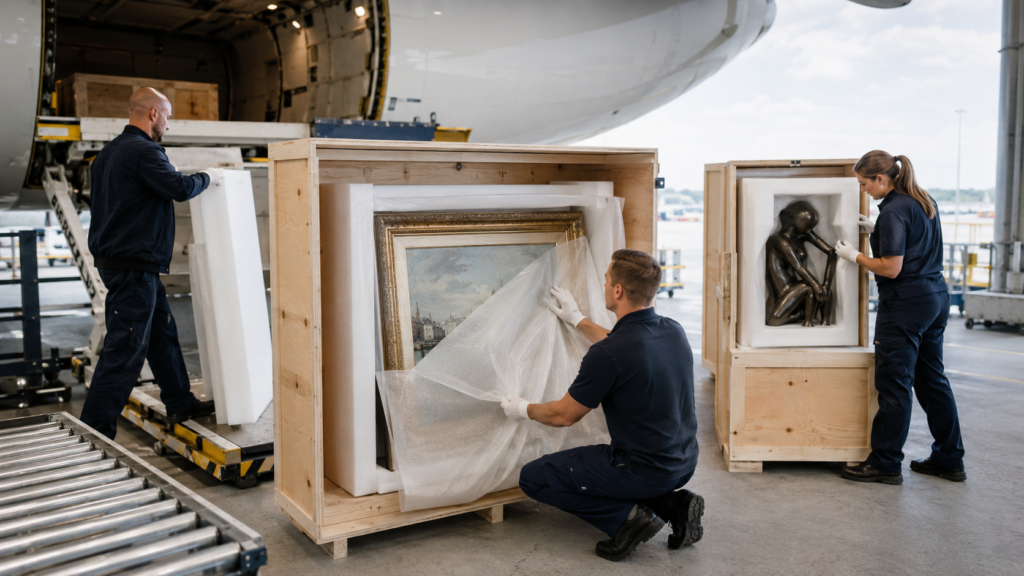
The crate is not just a box. It is a protective system designed around the object. For high-value art, packaging may include acid-free materials, corner protection, cushioning layers, vapor barriers, shock absorption, and climate-aware construction. The goal is to protect the object from impact, vibration, moisture, dust, and sudden environmental changes.
Custom crating is especially important for large paintings, framed works, ceramics, glass, mixed-media pieces, and objects with irregular shapes. A crate should fit the artwork and its vulnerabilities, not the other way around. Reusing a generic crate may reduce short-term cost, but it can increase the risk of movement inside the package.
Documentation and Customs Clearance
International art shipping depends heavily on paperwork. Missing or inaccurate documents can delay the shipment even if the artwork itself is packed correctly. Typical documentation may include a commercial invoice, packing list, export or import permits where required, proof of ownership, insurance documents, customs codes, and loan agreements for museum objects.
Some artworks may also be subject to cultural property rules. These rules vary by country and can affect older objects, archaeological items, religious artifacts, or works considered part of national heritage. Before shipping, galleries and collectors should check whether an export license or special declaration is needed.
Collectors and galleries that need to understand how international air freight works for specialized cargo can find a broader overview here.
Insurance Is Not a Substitute for Risk Management
Insurance is essential for high-value art, but it should not be treated as the main protection strategy. A payout cannot restore the historical value of a rare object or repair the reputational damage caused by a missed exhibition opening. Insurance works best when combined with preventive measures: professional packing, secure routing, clear handling instructions, and reliable tracking.
Collectors should also read the policy carefully. Coverage may depend on declared value, approved packing methods, transport provider, storage conditions, and whether the object was inspected before shipment. Some policies may exclude damage caused by poor packaging or insufficient documentation.
Security and Chain of Custody
High-value art requires a clear chain of custody. Every handover should be traceable, from collection and packing to airport delivery, customs clearance, arrival, and final installation. This is especially important for private collections, auction shipments, and museum loans.
Security may include sealed crates, controlled access, supervised loading, GPS tracking, secure storage, and limited disclosure of shipment details. The fewer unnecessary people know about the object, its value, and its route, the lower the exposure to theft or mishandling.
Climate Sensitivity and Transit Time
Many artworks are sensitive to environmental changes. Paint, wood, paper, textiles, and organic materials can expand, contract, warp, or become brittle when exposed to unstable humidity and temperature. Air freight can reduce total exposure time, but it does not remove the need for climate-aware planning.
The most vulnerable points are often not the flight itself but the periods before and after it: warehouse storage, airport handling, customs inspection, truck loading, and final delivery. That is why galleries should ask how the artwork will be stored and whether the route includes long waits in uncontrolled environments.
Practical Checklist Before Shipping Art by Air
Before arranging international air freight for a valuable artwork, collectors and galleries should confirm several points:
- Confirm the artwork’s condition. Create a detailed condition report with photographs before packing. This protects both the owner and the logistics partners.
- Choose the right crate. The crate should match the artwork’s material, size, fragility, and climate sensitivity.
- Prepare customs documents early. Do not wait until the shipment is ready to move. Delays often begin with missing paperwork.
- Check insurance terms. Make sure the declared value, packing method, and route are covered.
- Plan the final mile. Many damage risks appear after arrival, during unloading, unpacking, or installation.
Final Thoughts
Shipping high-value art by air can be a safe and efficient way to move important works across borders, but only when the process is carefully managed. The aircraft is just one part of the journey. Packaging, documentation, customs clearance, insurance, security, and environmental control all play a role.
For collectors and galleries, the key lesson is simple: valuable art should never be treated as ordinary freight. A successful shipment protects not only the object itself but also the trust between owners, buyers, institutions, and audiences.